
TIRE TIPS // DRIVING
Chinooks and Black Ice in the Foothills
THE SHORT ANSWER
A chinook melts snow during the day and the melt refreezes into black ice as soon as the sun drops, which is why the worst driving of an Okotoks winter often happens on a plus-ten afternoon. Slow down before the shaded spots, bridges and intersections, and leave far more room than the bare-looking pavement suggests.
Why a warm day is the dangerous one
Newcomers assume the bad driving day is the blizzard. Anyone who has lived here a few winters knows better. The blizzard makes everybody careful. The chinook makes everybody comfortable, and comfortable is what puts a car in the ditch.
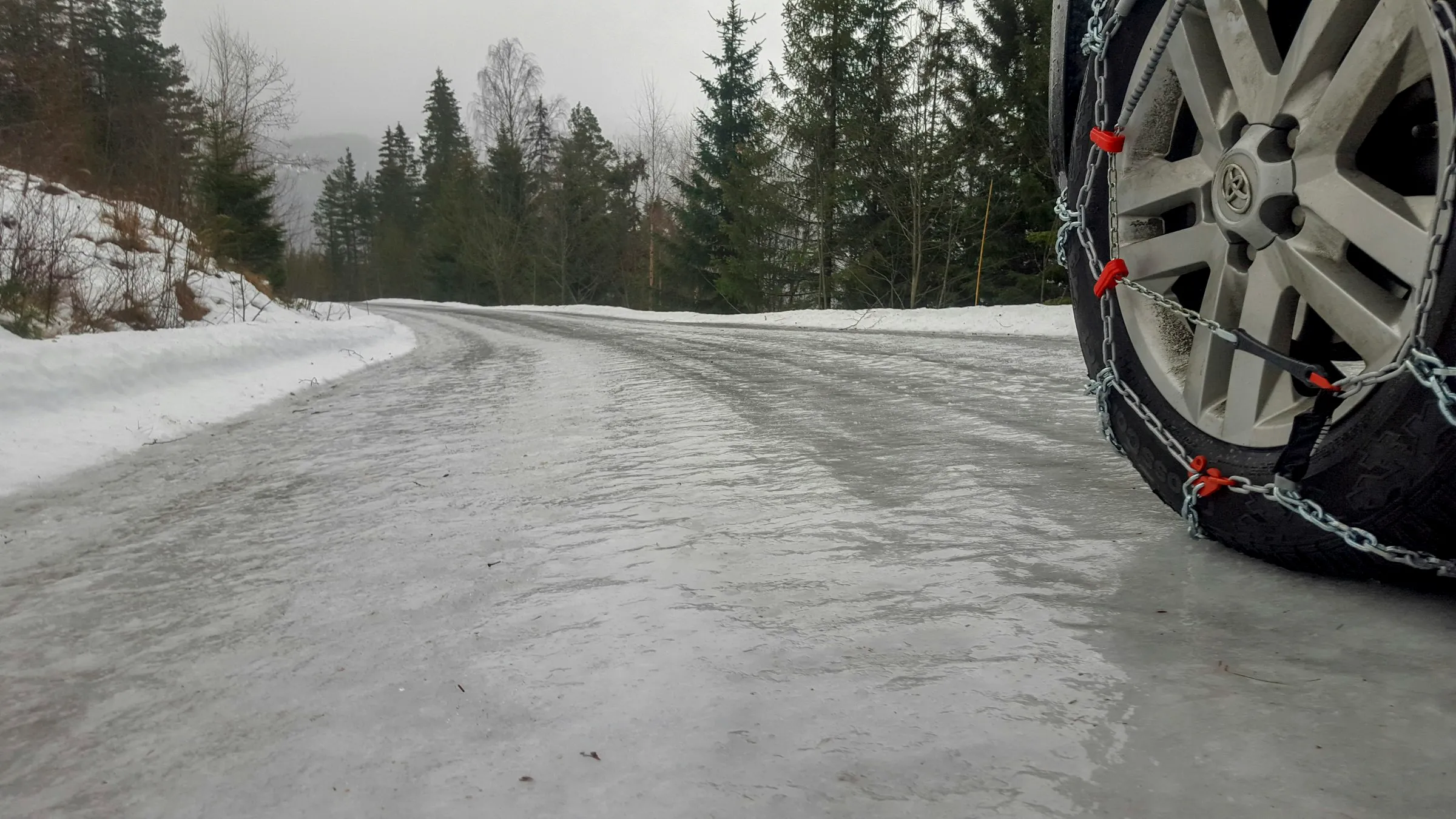
The mechanism is simple. A chinook arch parks over the Foothills, the temperature climbs to plus ten or twelve, and the snow pack starts to melt. Water runs off the banks, across the road, and sits there looking like nothing. The sun drops behind the mountains around half past four and that water becomes a sheet of ice on a road that still looks wet. By the evening commute you are driving on a skating rink that photographs like bare pavement.
The same thing repeats on the back side of the chinook, when the temperature falls twenty degrees in a few hours and everything that melted locks up at once.
Where the Foothills freeze first
The freezing is not even, and knowing the pattern is most of the skill.
Bridges and overpasses go first, because they lose heat from underneath. Every overpass on Highway 2 between Okotoks and Calgary is a candidate.
Shaded cuts freeze next. The stretch of Highway 7 west of town where the road runs below the bank, the treed sections down into the Sheep River valley, and any north-facing hill hold ice hours after the open road has dried.
Intersections are the classic Okotoks version. Southridge Drive and Milligan Drive collect melt water that runs downhill, packs under tires all afternoon, and polishes into glare ice right where everybody brakes.
Then the range roads. Gravel that thawed on top and froze solid is the worst surface in the Foothills, and it is the reason acreage drivers here run studs when town drivers do not need them.
How to read the road at speed
Look for the sheen. Fresh wet asphalt scatters light and looks dull grey. Ice reflects it, so a patch that looks glossier or darker than the road around it usually is. In the last hour of daylight, watch for that shift as you come out of the sun into shade.
Watch the spray from the vehicle ahead. If cars were throwing water and suddenly stop throwing it, the water is now ice.
Listen. Tire noise drops away on ice. If the road goes quiet, treat it as ice until it gets loud again.
Feel the steering. Ice makes the wheel go light, several seconds before anything else tells you.
What to do when you are on it
Do less, and do it slower. The mistake in a slide is a fast input, and the fix is almost always to take your feet off everything and steer where you want to go.
Braking on ice: get off the throttle early and brake in a straight line before the corner, not in it. If ABS starts hammering, keep firm pressure on the pedal and let it work. That noise is the system doing its job.
Cornering on ice: slow down to a speed you would be comfortable holding through the whole corner before you turn in, then hold it. Adding brakes mid-corner is how a car ends up pointing backwards.
Hills: momentum before the climb, no throttle spikes on it, and on the way down use a lower gear so the engine holds the speed instead of the brakes.
Following distance: whatever you use in summer, double it, then double it again on a chinook evening. Most winter collisions here are rear-enders at low speed, and every one of them is a following-distance problem.
What tires actually change
Tires do not change physics, they change the size of the margin. On glare ice from 50 km/h, a modern winter tire routinely stops a car length or more shorter than an all-season, and a studded tire shortens it again. That car length is the difference between the intersection and the middle of it.
What tires do not do is give you back the time you did not leave yourself. An all-wheel-drive vehicle on all-seasons accelerates beautifully and stops like everything else, which is why so many of the trucks in the ditch on a bad morning are the ones that felt most confident on the way there.
The other honest limit: below about minus thirty, every tire is compromised and ice is at its most polished. That is a day to leave earlier and drive slower whatever is fitted.
The chinook checklist
Before a chinook week: check your tire pressures, because a twenty-degree temperature swing moves them by several psi in both directions.
During the melt: assume any wet patch after four in the afternoon is about to be ice.
After the freeze: expect the worst surfaces in the shade and at the bottom of hills, and expect the range roads to be worse than the highway.
All season: keep the washer bottle full of winter fluid and the wipers fresh, because the second half of every chinook is a windshield covered in grit and salt spray.
Quick answers
Is black ice really invisible? Nearly. It is clear ice over dark pavement, so you are seeing the road through it. The tell is the sheen and the quiet.
Does all-wheel drive help on ice? For getting moving, yes. For stopping and turning, no. Braking grip comes from tires.
Should I pump the brakes? No. Modern cars have ABS. Press firmly and hold, and let it pulse.
Are studs worth it just for chinooks? If your route includes gravel, shaded hills or a steep driveway, yes. For highway and cleared streets, a good studless winter tire is enough.
What speed is safe on ice? Slower than you think, and slow enough that you are not braking or steering hard for anything you can already see.
GOOGLE REVIEWS // OKOTOKS & FOOTHILLS
All reviews★★★★★
I called on a Thursday to get three of my four trailer tires replaced. Got booked in for 9:00 a.m. on Saturday. Arrived at 9am and all done by 9:30am. Very fast and efficient. Would highly recommend.
★★★★★
Great service for an excellent price. Would highly recommend these guys!
★★★★★
I struggle to find a place that will work in smaller lawn tractor tires without feeling like I’m inconveniencing the place. These guys are awesome and get shit done !
★★★★★
Great service and care.
★★★★★
Excellent place for tires in Okotoks. Super friendly staff, professionals and great prices.
★★★★★
What a great experience. Fast friendly and decently priced tires for our Kia Sorento. We were in and out in 20 mins and had no issues at all. Highly recommend for tire and service!!
★★★★★
I called in for an issue with my tire. They were very professional and attentive. Service was very quick and my issue was resolved. Great group of people working here and they are the best in town for tires and more.
★★★★★
Completely satisfied, great service. Braeden and Pat were both fantastic to deal with.
★★★★★
Excellent prices, super service and above all a great team of knowledgeable & personable staff. Can't recommend them highly enough.
★★★★★
Absolutely fantastic service. We got a flat tire and they were the closest place so glad it was. Clean shop, honest prices, friendly staff.
★★★★★
Great service, great prices, great business. Highly recommended if you need some new rubber!
★★★★★
This was a great experience. They responded to me fast. Helped me with my enquiry. I recommend them over and over.
★★★★★
I always like to give my business to local family businesses and Rim 2 Rim are a great tire shop. Competitive and friendly efficient staff. Helped me out in a pinch with flat tire at short notice
★★★★★
Got us in during a busy time and very reasonably priced
★★★★★
Awesome experience!! Friendly and fast thanks a lot.
★★★★★
Pat and his team are great. Get you in on time and out quickly. Professional and courteous staff. My go-to for all my tire work!
★★★★★
Owner and staff are always the best. Great service.
★★★★★
Amazing service when conducting my out of province inspection…highly recommended
★★★★★
This place was great to deal with. Got me in within a timely manner!! Great service, guy up front great guy to deal with. I will be going back there!!
★★★★★
Great service and a great price. Would highly recommend.
★★★★★
Fast and professional service from friendly staff. An excellent experience overall.
★★★★★
I had a punctured tired and they helped us out right away! Great service!
★★★★★
Traveling though the area these guys were great when I needed a new trailer tire on my RV, luckily they had the tire in stock and once I brought them the rim service was excellent to get me right back on the road!
★★★★★
This is hands down the best place for tires and service. Their prices beat all places I've been to and the owner is great. All the staff are friendly and very helpful!
★★★★★
Great price for trailer tires had 4 tires changed and was done in 1/2 hour. Will definitely be doing more business with this shop
★★★★★
Great bunch of people and had an awesome experience. Thanks for looking after my 2003 Acura EL, never driven better!
★★★★★
Awesome service, as usual, even though he was booked solid, Pat still managed to squeeze me in for an 'emergency' repair. So grateful - knew I could rely on Rim 2 Rim.
★★★★★
Best tire shop in the area by far. Pat and the crew are the best!! I wouldn't go anywhere else.
FIND US
Located Downtown
Okotoks
7 S Railway St, Okotoks, AB T1S 1A4
By the tracks, serving Okotoks, High River, Calgary and the Foothills.
| MON – THU | 8:00 AM – 5:30 PM |
|---|---|
| FRI | 8:00 AM – 5:00 PM |
| SAT | 9:00 AM – 1:00 PM |
| SUN + STAT | CLOSED |