
TIRE TIPS // SAFETY
10 Signs You Need New Tires
THE SHORT ANSWER
Replace tires when the wear bars are flush with the tread, when winters drop under about 4 mm, when the sidewall is cracked or bulging, or when the DOT date says they are past about ten years. Uneven wear and new vibration usually mean something else on the vehicle needs fixing first.
1. The wear bars are flush with the tread
Every tire is moulded with small raised bars running across the bottom of the grooves. When the tread wears down level with them, the tire is finished. That point is 1.6 mm, and it is the legal floor in the provinces that set one.
Flush wear bars are not a suggestion. Wet braking falls off a cliff in the last couple of millimetres, and so does anything on snow.
2. Your winters are under about 4 mm
Winter tires stop working as winter tires long before they are legally worn. The rule the trade uses is about 4 mm, roughly 5/32 of an inch, and below that the sipes and the snow-holding tread blocks are gone even though there is rubber left.
We measure at the changeover and tell you where you are, so nobody finds out in a November parking lot.
3. The quarter test says shallow
No gauge handy? Put a quarter into the groove with the caribou's nose pointing down. If the top of the nose is showing, you are down near 4 mm and it is time to plan for winters. A penny works for the legal minimum, but by then the decision has made itself.
4. One edge is worn and the other is not
Wear on the inside or outside shoulder only is an alignment problem, not a tire problem. Buying tires without fixing it means buying tires again next year. The details are in our alignment signs guide, and it is worth reading before you pay for rubber.
Wear in the centre only usually means chronic overinflation. Wear on both shoulders with a good centre means chronic underinflation.
5. The tread is cupped or scalloped
Run your hand around the tread. If it feels like a series of dips, the tire has been bouncing rather than rolling, which points at worn shocks or struts, or a bad imbalance. Cupped tires get loud, and they stay loud on the new set unless the cause is dealt with.
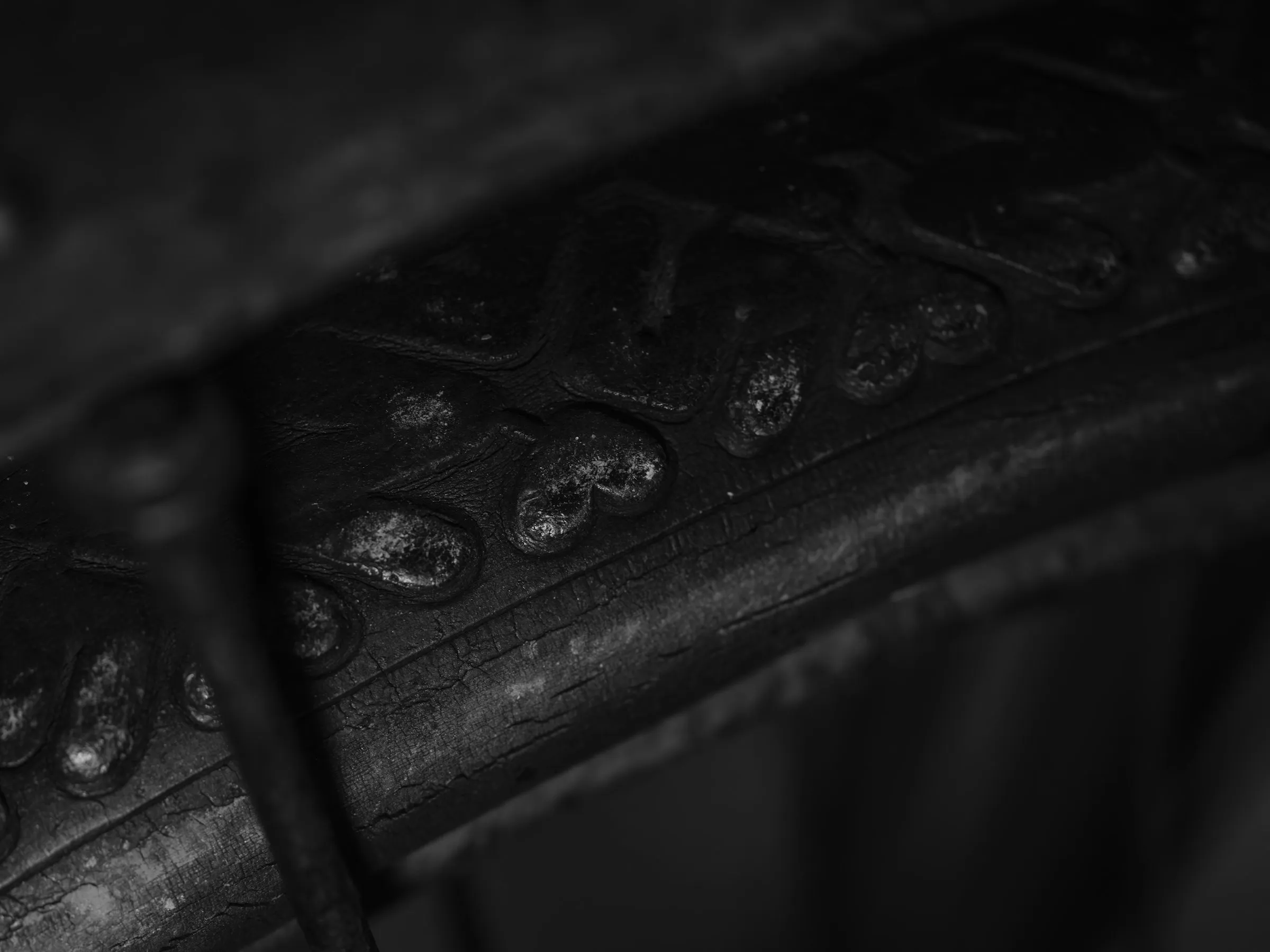
6. Cracks in the sidewall or between the tread blocks
Fine cracking, sometimes called weather checking, is rubber that has aged and dried. Alberta is hard on tires this way: dry air, hard UV in summer, and swings from plus thirty to minus thirty every year.
Surface cracks on an otherwise good tire are a watch item. Cracks deep enough to see into, or cracking around the whole sidewall, mean replace.
7. A bulge, a blister or a flat spot
A bulge in the sidewall is a broken cord under the rubber, usually from a pothole or a curb. It is the one item on this list that means stop driving on it now, because the failure mode is a blowout rather than a slow leak.
Milligan Drive and the county roads produce a crop of these every spring.
8. Vibration that was not there last month
New vibration at highway speed usually means a wheel weight thrown, a tire out of round, or a bent wheel from a pothole. Some of that is fixable with a rebalance and some is not, but ignoring it wears the tire, the shocks and the bearings together.
Vibration you feel in the steering wheel is usually the front. Vibration you feel in the seat is usually the back.
9. It keeps losing air
A tire that needs topping up every couple of weeks has a leak, and most of them are repairable. A nail in the tread area gets a proper plug and patch from the inside. A puncture in the shoulder or sidewall does not: that tire is finished, whatever the internet says about kits.
If nothing is in the tread, the leak is often the valve, the sensor seal or corrosion on the bead where the tire meets the wheel, which is normal on Alberta alloys after a few salted winters. Our tire repair page covers what can be saved.
10. The DOT date is old
The last four digits of the DOT code are the week and year the tire was built. Rubber ages whether or not you drive on it, and an old tire hardens the same way a cold tire does.
Watch tires from about six years on, and replace them by about ten regardless of how much tread is left. This is the one that catches trailers, RVs and second vehicles, where the tread can look new at fifteen years old and the rubber underneath has nothing left.
Quick answers
How much tread do I legally need? 1.6 mm is where the wear bars sit and where the legal floor is set in provinces that specify one. Alberta's commercial standard for a steering axle is 3 mm, which tells you what the industry thinks of 1.6.
Can I replace just two tires? For a summer set, sometimes, and the new pair goes on the rear for stability. For winter, buy four.
Do tires expire? They age. Six years is when to start watching, ten is the practical limit.
My tires look fine but the car pulls. That is alignment or pressure, not tread. Get it checked before the wear starts.
Is a plug enough for a nail? A proper repair is a plug and patch fitted from the inside, in the tread area only. Anything in the sidewall or shoulder is not repairable.
GOOGLE REVIEWS // OKOTOKS & FOOTHILLS
All reviews★★★★★
I called on a Thursday to get three of my four trailer tires replaced. Got booked in for 9:00 a.m. on Saturday. Arrived at 9am and all done by 9:30am. Very fast and efficient. Would highly recommend.
★★★★★
Great service for an excellent price. Would highly recommend these guys!
★★★★★
I struggle to find a place that will work in smaller lawn tractor tires without feeling like I’m inconveniencing the place. These guys are awesome and get shit done !
★★★★★
Great service and care.
★★★★★
Excellent place for tires in Okotoks. Super friendly staff, professionals and great prices.
★★★★★
What a great experience. Fast friendly and decently priced tires for our Kia Sorento. We were in and out in 20 mins and had no issues at all. Highly recommend for tire and service!!
★★★★★
I called in for an issue with my tire. They were very professional and attentive. Service was very quick and my issue was resolved. Great group of people working here and they are the best in town for tires and more.
★★★★★
Completely satisfied, great service. Braeden and Pat were both fantastic to deal with.
★★★★★
Excellent prices, super service and above all a great team of knowledgeable & personable staff. Can't recommend them highly enough.
★★★★★
Absolutely fantastic service. We got a flat tire and they were the closest place so glad it was. Clean shop, honest prices, friendly staff.
★★★★★
Great service, great prices, great business. Highly recommended if you need some new rubber!
★★★★★
This was a great experience. They responded to me fast. Helped me with my enquiry. I recommend them over and over.
★★★★★
I always like to give my business to local family businesses and Rim 2 Rim are a great tire shop. Competitive and friendly efficient staff. Helped me out in a pinch with flat tire at short notice
★★★★★
Got us in during a busy time and very reasonably priced
★★★★★
Awesome experience!! Friendly and fast thanks a lot.
★★★★★
Pat and his team are great. Get you in on time and out quickly. Professional and courteous staff. My go-to for all my tire work!
★★★★★
Owner and staff are always the best. Great service.
★★★★★
Amazing service when conducting my out of province inspection…highly recommended
★★★★★
This place was great to deal with. Got me in within a timely manner!! Great service, guy up front great guy to deal with. I will be going back there!!
★★★★★
Great service and a great price. Would highly recommend.
★★★★★
Fast and professional service from friendly staff. An excellent experience overall.
★★★★★
I had a punctured tired and they helped us out right away! Great service!
★★★★★
Traveling though the area these guys were great when I needed a new trailer tire on my RV, luckily they had the tire in stock and once I brought them the rim service was excellent to get me right back on the road!
★★★★★
This is hands down the best place for tires and service. Their prices beat all places I've been to and the owner is great. All the staff are friendly and very helpful!
★★★★★
Great price for trailer tires had 4 tires changed and was done in 1/2 hour. Will definitely be doing more business with this shop
★★★★★
Great bunch of people and had an awesome experience. Thanks for looking after my 2003 Acura EL, never driven better!
★★★★★
Awesome service, as usual, even though he was booked solid, Pat still managed to squeeze me in for an 'emergency' repair. So grateful - knew I could rely on Rim 2 Rim.
★★★★★
Best tire shop in the area by far. Pat and the crew are the best!! I wouldn't go anywhere else.
FIND US
Located Downtown
Okotoks
7 S Railway St, Okotoks, AB T1S 1A4
By the tracks, serving Okotoks, High River, Calgary and the Foothills.
| MON – THU | 8:00 AM – 5:30 PM |
|---|---|
| FRI | 8:00 AM – 5:00 PM |
| SAT | 9:00 AM – 1:00 PM |
| SUN + STAT | CLOSED |